 By
By The Distinction That Changes Everything
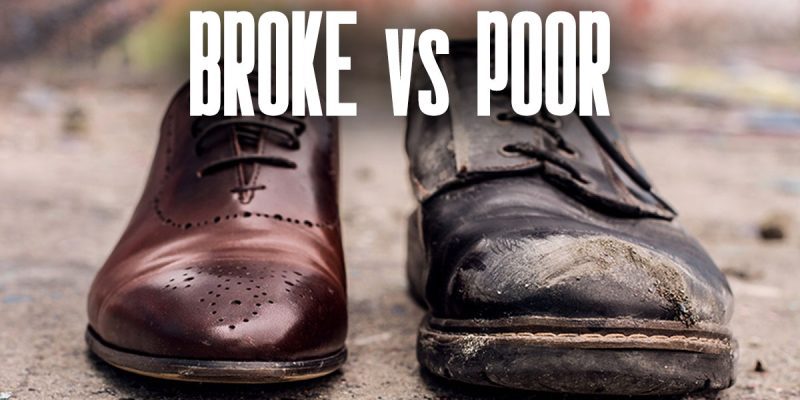
Broke means you’ve run out of money. Poor means you don’t have enough income to meet your basic needs consistently, regardless of how carefully you manage it.
These feel similar from the inside, but they have very different causes and very different solutions. The broke person earning $80,000 per year who spends $85,000 is in a behavioral and systems problem. The poor person earning $28,000 in a city where housing alone costs $20,000 per year is in a structural problem that no amount of behavioral change will fully resolve.
Personal finance advice is mostly written for the broke — the people whose income is theoretically sufficient but whose management of it is the problem. For the genuinely poor, the behavioral advice (make a budget, cut subscriptions, cook at home) is often irrelevant because there are no subscriptions to cut and the budget has been ruthlessly trimmed for years. The advice is irritating because it assumes a problem that doesn’t describe their situation.
Signs You’re Broke Rather Than Poor
Broke typically has identifiable behavioral and structural causes that income alone would resolve if managed differently. Signs:
Your income is above the median for your area but you have nothing saved. This strongly suggests spending patterns rather than income insufficiency.
You have lifestyle expenses (subscriptions, dining, vehicles, housing) that exceed what your income can sustain. Lifestyle inflation has consumed income growth.
You don’t actually know where your money goes. Genuine inability to account for where income goes is almost always a broke problem, not a poor problem — genuinely poor people account for every dollar because they have to.
You’ve never seriously budgeted. If you’ve never built a real budget and tracked actual spending, you don’t actually know whether your income is insufficient or just poorly managed.
Signs You’re Poor Rather Than Just Broke
Genuine poverty has different characteristics:
You’ve cut everything discretionary and still can’t make rent. When the budget has no obvious fat — when housing, food, basic transportation, and utilities consume all available income — the problem is income, not management.
Your income is fundamentally below the cost of basic needs in your area. This is a structural problem. A budget doesn’t help when income minus housing leaves nothing for food.
You’re working multiple jobs or maximum hours and still in deficit. The problem isn’t effort; it’s earning capacity relative to cost of living.
You lack access to the financial products that would help. No banking relationship, no credit history, no access to emergency credit except predatory lenders — these are poverty characteristics, not broke characteristics.
Different Problems, Different Solutions
For broke situations — income is theoretically sufficient but management is the problem:
Budgeting, automation, spending awareness, lifestyle reduction, debt payoff, and savings habits are the correct interventions. These are behavioral problems with behavioral solutions.
For genuinely poor situations — income is structurally insufficient for the cost of living:
Income growth (job training, credential building, career change, second income, geographic move to lower cost area) is the necessary intervention. Behavioral finance tools can optimize what’s available, but they can’t substitute for income that doesn’t exist.
Government assistance programs exist specifically for income-insufficient situations: SNAP, Medicaid, housing assistance, utility assistance, childcare subsidies. Using these programs is using resources created specifically for structural income insufficiency — there’s no shame in that.
The Complexity in Between
Many people are simultaneously dealing with both structural income constraints and suboptimal financial management. A household earning $55,000 in a city where basic needs cost $50,000 is experiencing structural constraint, but better management might free $5,000 for savings or emergency reserves. Both dimensions are real.
The honest self-assessment is worth doing without judgment: if your income doubled, would your financial stress resolve? If yes, you’re probably in the broke category. If you’d still be struggling at double income, you likely have both structural and management components.
The value of the distinction isn’t to assign blame — it’s to direct effort correctly. The broke person who treats themselves as poor and focuses on income growth while ignoring management may achieve income growth and still end up broke. The poor person who treats themselves as broke and focuses on budgeting while ignoring income growth will optimize their poverty without escaping it.