
 By
By The ‘Unexpected’ Expense That Was Never Unexpected
Here’s a financial paradox that plays out in millions of households every single year: people are “surprised” by completely predictable expenses.
Car registration due in April. Always due in April. Every year. Somehow every April, it’s a surprise. Christmas in December. Every year. Somehow every December, the credit card bill in January is a surprise. Annual insurance premium. Annual subscription renewals. Back-to-school shopping. Quarterly tax estimates for self-employed people. Vet bills for pets, which come up regularly whether or not there’s an emergency.
These are not unexpected expenses. They are expected expenses that people don’t plan for. And the difference between planning for them and not planning for them is the difference between your financial life feeling manageable and your financial life feeling like a constant series of crises.
Sinking funds are the solution, and they’re one of the most practical and underused tools in personal finance.
What a Sinking Fund Is and How It Works
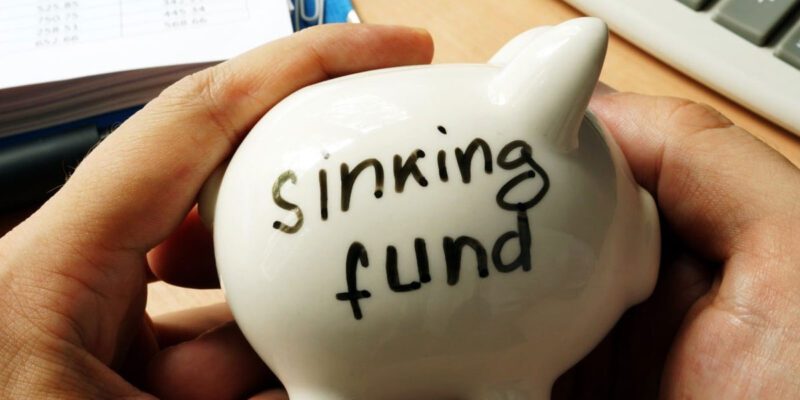
A sinking fund is a dedicated savings pot for a specific expected future expense. You divide the total anticipated cost by the number of months until you need the money, and you save that amount each month.
Car registration costs $400 per year? Save $33 per month into a “car registration” fund. Christmas gifts typically run $600? Save $50 per month. Annual vacation costs $2,400? Save $200 per month. Home maintenance (experts typically recommend budgeting 1-3% of home value per year) on a $250,000 home? Save roughly $200-625 per month.
When the expense comes due, you pay from the fund. No credit card required. No disruption to your budget. No “surprise.” The expense was never a surprise — you just planned for it.
This is the unsexy version of financial management that makes everything else work. It’s not complicated. It’s just consistent.
The Most Common Sinking Funds Worth Setting Up
You don’t need a sinking fund for everything. You need one for any expense that’s large enough to disrupt your regular budget and predictable enough to estimate in advance.
Car maintenance and repairs: even if you can’t predict exactly when something will break, you can predict that something will. A $100-150 per month car maintenance fund means most repairs are covered without borrowing.
Home maintenance: the hot water heater that needs replacing, the roof that needs work, the HVAC that will eventually fail. These are not surprises for homeowners; they’re certainties. A dedicated fund makes them manageable rather than financial crises.
Medical expenses: even with good insurance, predictable out-of-pocket costs occur. If you have regular prescriptions, a chronic condition, or know you’ll need dental work, set aside a monthly amount.
Annual subscriptions and memberships: add up all your annual renewals and divide by twelve. Set that aside monthly.
Travel: if you take a vacation once or twice a year, the cost is predictable. Saving monthly for it means you pay cash rather than financing the vacation on a credit card.
Personal and family celebrations: birthdays, anniversaries, holidays, graduations. These happen on predictable schedules. Save monthly.
Where to Keep Sinking Funds
The logistics of sinking funds matter. If you try to track twelve different mental categories in your regular checking account, you’ll spend the money accidentally or forget what’s reserved for what.
Two practical approaches. First, if your bank allows multiple savings accounts or savings “buckets” with custom labels, use them. Banks like Ally allow you to create multiple savings buckets within one savings account and name each one. The money is all in one account but you can see exactly how much is allocated to each purpose. This is my preferred approach because it’s simple and visible.
Second, keep a spreadsheet or note alongside a single savings account. The account holds all your sinking fund money; the spreadsheet tracks how much of the total belongs to each fund. A bit more manual but works fine.
The sinking funds should be in a different account from your regular emergency fund. The emergency fund is for genuinely unexpected situations (job loss, medical emergency, major unplanned repair). Sinking funds are for planned expenses. Mixing them creates confusion about how much genuine emergency coverage you have.
The Psychology of Pre-Paying Expenses
There’s an often-overlooked psychological benefit to sinking funds that goes beyond the practical money management.
When a large expected expense arrives and you have the money ready, you experience it very differently than when it arrives and you don’t. The difference between “my car registration is due, let me transfer from my car fund” and “my car registration is due, where am I going to find $400 this month” is the difference between financial calm and financial anxiety.
Sinking funds convert large, occasional expenses into small, regular ones. Psychologically, this makes your expenses feel more manageable because nothing feels like a sudden hit to your budget. The money left over each month after regular bills and sinking fund contributions is genuinely available to spend or save. There’s no phantom expense hiding around the corner waiting to destabilize everything.
This predictability, knowing exactly what’s coming and having it covered, is one of the most underrated contributors to financial wellbeing. It’s not exciting. It doesn’t involve sophisticated strategies. It requires only the discipline to move money to named accounts on a monthly schedule. And the peace of mind it creates is genuinely significant.
Building Your Sinking Fund System This Month
Step one: list every large, predictable expense you’ve been “surprised” by in the past two years. Car repairs, medical bills, holiday spending, annual subscriptions, home stuff, travel, anything. Write down each item and your best estimate of the annual cost.
Step two: add them up. Divide by twelve. That’s your monthly sinking fund contribution total. For most people this is between $200 and $600 per month.
Step three: open the accounts or create the tracking system. Name everything specifically. Not “car stuff” but “car maintenance” and “registration” as separate lines.
Step four: set up automatic monthly transfers for each fund on payday.
Step five: resist the temptation to use the funds for non-designated purposes. The car fund is for car expenses. Using it to cover a dinner out resets the whole purpose.
The first month you have an “unexpected” expense arrive and you just pay it from the fund without any drama, you’ll understand why people who use this system become evangelists for it. The absence of financial panic around predictable expenses is worth far more than the modest organizational effort required.