
 By
By The Catering Cost Reality
Wedding catering is consistently the largest or second-largest wedding expense for most couples, often running $75 to $150 per guest for a full sit-down dinner with open bar. For a 100-guest wedding, that’s $7,500 to $15,000 in catering alone — before linens, rentals, service charges, and gratuity that add another 20 to 30 percent.
The average wedding caterer’s invoice arrives after a pleasant tasting where everything was delicious, a positive relationship has been built, and the couple has mentally committed to the company. At that point, negotiating feels awkward and alternative research feels disloyal. The catering industry benefits enormously from this emotional sequencing.
Starting the conversation about catering from a position of knowing what alternatives cost, what’s actually negotiable, and what your specific priorities are produces dramatically better outcomes than the standard process.
The Per-Person Price Breakdown: What You Can Negotiate
Traditional wedding caterers bundle everything into a per-person price that obscures what you’re actually paying for. Breaking this down reveals what’s negotiable.
Food cost at the catering company’s supply prices typically represents 28 to 35 percent of the per-person charge. Labor (service staff, setup, breakdown) typically represents 30 to 35 percent. Overhead and profit make up the balance.
Parts of this that are often negotiable: the service charge percentage (typically 18 to 22 percent on top of food and labor), the specific staffing level (one server per table vs. one per two tables), gratuity (separate from service charge at some companies), the specific rentals included in the package versus rented separately.
Items that are rarely negotiable: food cost itself (though menu simplification reduces total cost), minimum guest counts.
Alternative Catering Formats That Cost Less
The sit-down plated dinner is the most expensive wedding catering format. Alternatives that feed guests as well and often more memorably, for less:
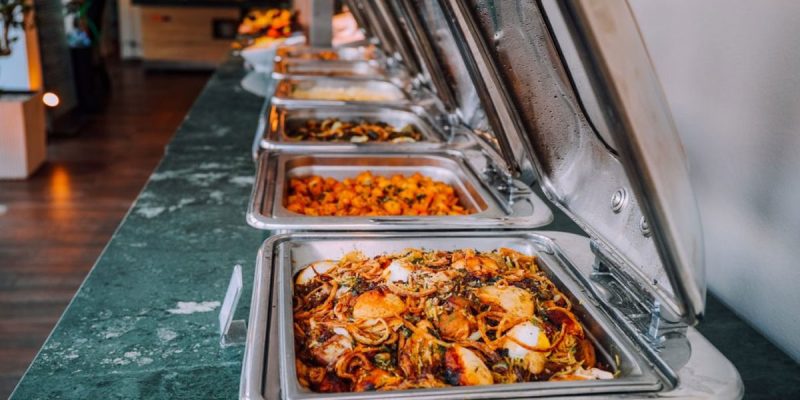
Buffet service: eliminates per-plate service labor, allows guests to choose what they want, and often creates a more relaxed, social atmosphere. Buffets typically cost 15 to 25 percent less per person than plated dinners for equivalent food quality.
Food stations: a grazing or station format with multiple themed food stations (Italian, carving station, salad bar, dessert) provides variety, visual interest, and conversation pieces. Often priced similarly to or slightly below buffets.
Family style: large platters of food for each table, passed among guests, creates a communal atmosphere and reduces labor compared to plated service. Often beloved by guests and priced competitively.
Food trucks: for the right venue and couple aesthetic, food truck catering can be distinctive, less expensive, and genuinely delicious. Multiple trucks offering different cuisines provide variety. The informal format pairs naturally with outdoor venues and younger guest demographics.
The Bar Question: Open Bar Alternatives
Open bar is often the second-largest catering cost after food, running $25 to $75 per person depending on what’s included and the length of service. Modifying the bar format provides some of the easiest catering savings.
Beer and wine only is the most common open bar reduction, typically saving $15 to $30 per person compared to full open bar with spirits. For weddings where the guest demographic drinks primarily wine and beer anyway, eliminating premium spirits service makes practical sense.
Drink tickets (two or three per person) provide a guest experience somewhere between open bar and cash bar that allows guests some complimentary drinks without unlimited consumption costs.
Signature cocktail plus wine and beer is a popular modern format: one or two specialty cocktails are pre-batched and served at a lower cost than a full cocktails bar, wine and beer are open, and premium spirits are either absent or cash only.
The Grocery Store and Restaurant Alternative
For smaller weddings (under 50 guests), DIY catering from a restaurant you love or from grocery store prepared foods is worth seriously considering. A restaurant that doesn’t typically cater may be willing to prepare large quantities of their dishes for off-site service at below-catering-company prices. A grocery store’s deli department can provide trays of prepared foods, rotisserie chickens, and salads that make a legitimate casual wedding dinner.
This requires more coordination than hiring a caterer, and someone needs to be responsible for the food setup and management during the reception. For a couple with organized friends or family who can take this on, the savings can be $3,000 to $8,000 compared to professional catering at a 50-person wedding.
The key risk to manage: food safety. Hot food needs to stay hot (above 140°F), cold food needs to stay cold (below 40°F), and the setup needs to handle the timeline between food preparation and service without extended periods in the temperature danger zone.