 By
By Why Most People’s Investment Instincts Are Wrong
If you ask most people when they want to invest money, the answer — often unspoken — is: when the market looks good and is going up. When they want to pull out: when the market looks scary and is going down.
This is completely backwards from what actually generates returns. Buying when prices are high and selling when they’re low is the surest way to lose money in the market. Yet this is what the majority of individual investors do, because our emotional responses to financial markets are poorly calibrated for the actual task of long-term wealth building.
The market goes up over long periods. But it goes up with tremendous volatility along the way. The volatility is what scares people into the wrong decisions. Dollar-cost averaging is a strategy specifically designed to neutralize those emotional wrong decisions by making them structurally impossible.
What Dollar-Cost Averaging Actually Means
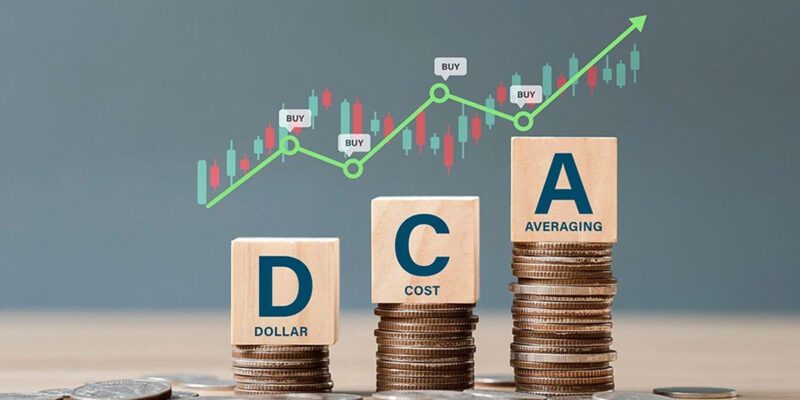
Dollar-cost averaging (DCA) means investing a fixed dollar amount on a fixed schedule, regardless of what the market is doing. If you invest $300 every month, you invest $300 when the market is high, $300 when it’s low, $300 when the news is scary, and $300 when everything looks great.
Because you’re investing a fixed dollar amount (not a fixed number of shares), you automatically buy more shares when prices are low and fewer shares when prices are high. Your average cost per share over time ends up lower than if you’d tried to time the market.
Let me make this concrete. Imagine a stock that goes through three months of price swings: Month 1: $10 per share, Month 2: $5 per share, Month 3: $10 per share. You invest $100 each month.
Month 1: $100 buys 10 shares at $10. Month 2: $100 buys 20 shares at $5. Month 3: $100 buys 10 shares at $10. You’ve invested $300 and own 40 shares. The stock is back to $10, so your 40 shares are worth $400. You’ve turned $300 into $400 with no special insight, no market timing, just consistent investing through a dip.
A lump-sum investor who put in $300 at Month 1 at $10 per share owns 30 shares worth $300 when the stock returns to $10. They’ve broken even. The DCA investor made 33% more with the same total investment.
The Power of Removing Emotion From Investing
The greatest practical advantage of dollar-cost averaging isn’t actually the mathematical benefit in volatile markets (though that’s real). It’s that the strategy is automatic and requires no decision-making once it’s set up.
You don’t have to assess whether this month is a good time to invest. You don’t have to check the news before moving money. You don’t have to overcome the fear of investing when the market just dropped 15%. The decision was made when you set up the automatic transfer. It executes regardless of how you feel about the market.
This removes the most dangerous element in individual investing: your own reactive decision-making. Studies of investor returns consistently show that individual investors underperform the market averages they’re invested in because of bad timing decisions — buying after good runs and selling during panics. Dollar-cost averaging structurally prevents these mistakes.
If you’ve ever pulled money out of the market during a scary news cycle and then watched it recover without your money in it, you understand this problem personally. DCA is the structural solution.
How to Implement It Practically
Most people are already using dollar-cost averaging without calling it that. Automatic 401k contributions deducted from each paycheck and invested in whatever funds you’ve selected: that’s dollar-cost averaging. The amount is fixed. The schedule is fixed. It invests regardless of market conditions.
For investments outside retirement accounts, the same principle applies. Pick an investment (a broad market index fund is the most commonly recommended starting point for good reason), decide on a monthly amount, set up an automatic investment on a fixed schedule.
Brokerage accounts at Fidelity, Vanguard, Schwab, and similar institutions all allow automatic recurring investments. You set it once. It runs indefinitely.
The choice of what to invest in matters, but for most people starting or building a long-term investment portfolio, a low-cost total market index fund or an S&P 500 index fund is a reasonable default. The expense ratio (annual cost) should be very low — the best index funds charge minimal fees. High-fee actively managed funds should be scrutinized carefully.
When Dollar-Cost Averaging Isn’t Optimal
Fairness requires acknowledging that research shows lump-sum investing (putting all available money in at once rather than spreading it out) beats dollar-cost averaging about two-thirds of the time when you have a lump sum available, simply because markets go up over time and your money spent less time out of the market.
So why recommend DCA? Because most people don’t have a choice. Investing happens from regular income, not from a windfall. Monthly contributions to a retirement or investment account is inherently DCA, not lump-sum.
For the specific situation of having a large sum to invest (an inheritance, a bonus, proceeds from selling property), the research-backed approach is to invest it promptly rather than spreading it over twelve months. The behavioral argument for spreading it out (you’ll feel less anxious) is real but doesn’t change the expected financial outcome.
For most people’s most common situation — regular income to invest monthly — dollar-cost averaging is not a compromise strategy. It’s exactly the right approach.