 By
By The Eternal Debt Payoff Debate
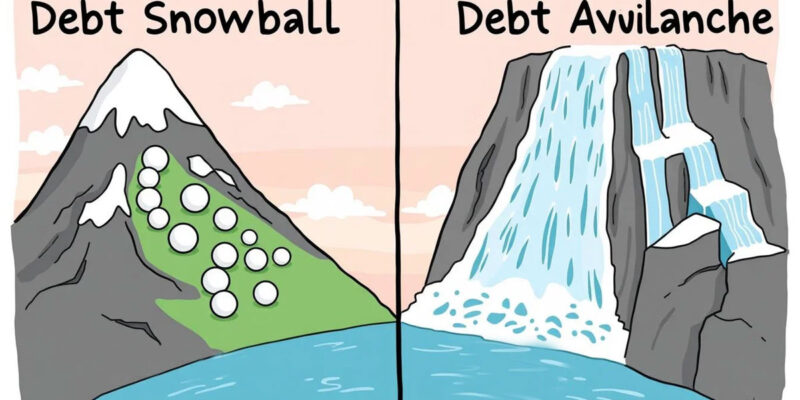
If you’ve done any reading on paying off debt, you’ve encountered the snowball versus avalanche debate. The avalanche side argues it’s mathematically superior and clearly the rational choice. The snowball side argues that motivation and behavior matter more than math in practice.
Both sides are partially right and both miss something. I want to give you the honest picture rather than picking a side, because the right approach genuinely depends on the person.
Let me start by explaining both methods clearly, because there’s a lot of confusion in how they’re described online.
The Debt Avalanche: How It Works
The debt avalanche method works like this: you list all your debts. You make the minimum required payment on every debt each month. Every dollar beyond the minimums goes toward the debt with the highest interest rate. When that debt is paid off, you redirect everything that was going to it (the minimum plus the extra) to the next highest interest rate debt. You continue down the list by interest rate until every debt is paid.
Why it’s mathematically optimal: by eliminating the most expensive debt first, you reduce the total amount of interest paid over the payoff period. On a collection of debts, the avalanche method typically saves hundreds to thousands of dollars in interest compared to other approaches, and usually reduces total payoff time.
A concrete example: imagine three debts — $5,000 credit card at 24% interest, $8,000 car loan at 7%, and $3,000 personal loan at 15%. The avalanche attacks the credit card first, then the personal loan, then the car loan. This is the mathematically cheapest path to debt freedom.
The limitation: the highest-interest debt isn’t always the smallest debt. If your biggest debt also has the highest interest rate, you might be paying extra on a $15,000 balance for two years before you see a single debt paid off. Some people sustain this motivation. Many don’t.
The Debt Snowball: How It Works
The debt snowball, popularized by Dave Ramsey, works differently: you list all your debts by balance, smallest to largest. You make minimum payments on everything. Every extra dollar goes toward the smallest balance debt. When that’s paid off, you roll the entire payment (former minimum plus extra) to the next smallest debt. The “snowball” refers to the growing payment amount you throw at each successive debt.
The attraction is psychological: you get a complete win — a debt fully paid off and eliminated — much sooner than with the avalanche method. That win is motivating. Some researchers have found that achieving small wins early increases persistence with the larger goal.
The limitation: you’re potentially ignoring high-interest debt to pay off low-interest debt. If your smallest debt is a $500 personal loan at 8% and your largest is a $15,000 credit card at 22%, paying the small loan first while the credit card accrues interest at 22% is objectively costly.
What Research Actually Shows
Academic research on this question produces nuanced results. Studies have found that the snowball method leads to higher payoff completion rates for some populations, supporting the psychological argument. But other research shows that the interest savings from the avalanche are real and significant enough to matter financially.
The most honest takeaway from the research: people who complete either method in full and stay debt-free are equally successful regardless of which method they used. The method doesn’t matter as much as actually doing it consistently.
The practical question is: which method are you more likely to actually complete? If you’re highly analytical, motivated by numbers, and genuinely understand the interest cost you’re accruing with the snowball on your specific debts — use the avalanche. If you’re motivated by visible progress and completing things, and worry that a long stretch with no wins will cause you to give up — the snowball is probably better for you even if it costs more on paper.
A Hybrid Approach Worth Considering
One approach that gets less attention: a hybrid that front-loads motivation without completely abandoning mathematical logic.
If you have one very small debt (say, $300-500) and several medium-to-large higher-interest debts, knocking off the small one quickly can be worth the modest extra interest cost for the motivational benefit. One fast win, then switch entirely to avalanche logic.
Alternatively: target a debt that’s almost paid off first, regardless of interest rate, to eliminate a monthly minimum payment quickly. That freed-up payment then accelerates the next debt on your avalanche list. The mathematical cost is small; the practical cash flow improvement of eliminating a monthly minimum is real.
The worst approach is having no strategy and making decisions about where to pay extra randomly or based on whatever you’re thinking about when you make a payment. Any consistent strategy beats the random approach significantly.
The Factor That Trumps Both Methods
Here’s the thing both methods agree on: the amount you put toward debt payoff matters more than the order. Increasing your monthly extra payment by $100 has more impact than choosing the “better” method.
Finding more money for debt payoff — through spending cuts, temporary extra income, redirecting windfalls — has a bigger impact on your payoff timeline and total interest paid than the avalanche versus snowball debate.
Cut spending in one category to free up $150 more per month for debt payoff. That $150 deployed consistently against your highest-interest debt will likely save more than the difference between the two methods on most debt configurations.
Focus on the amount, choose a method you’ll stick to, automate the payments, and get out of debt. The method is the least important variable in the equation.