
 By
By What Most People Actually Spend on Clothing (And Are Surprised By)
The average American spends over $1,700 per year on clothing and footwear. That number surprises most people because clothing purchases are incremental — a $30 top here, a $60 pair of jeans there, a $45 pair of shoes that were on sale. None of these feel significant. Together, they form a spending category that rivals some people’s car payments.
Fast fashion has made the incremental spending pattern worse by reducing the price of individual items while increasing the frequency of purchasing. When a top costs $12, you don’t think carefully about whether you need it or will actually wear it. When that same purchasing behavior happens thirty times a year, the math is surprisingly significant.
The problem isn’t just the money spent. It’s the money spent on things you don’t actually wear. Studies on wardrobe usage consistently find that the average person wears only about 20% of their wardrobe regularly. The other 80% — the impulse purchases, the sale items that didn’t quite fit right, the items bought for an occasion and never worn again — represents money spent that produced little value.
What a Capsule Wardrobe Actually Is
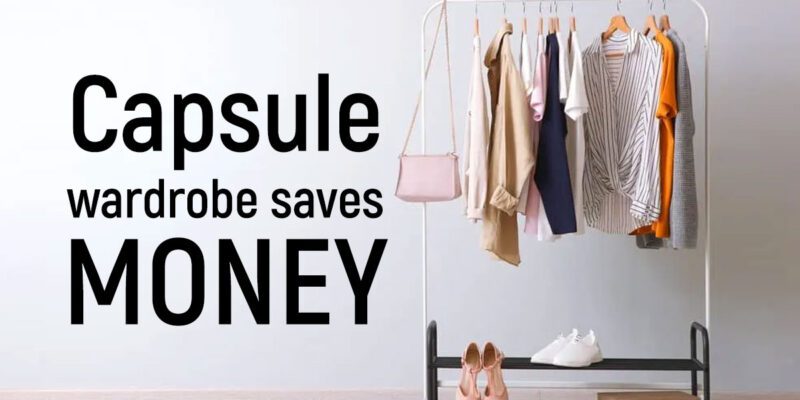
A capsule wardrobe is a curated set of versatile, high-quality clothing items that work together in many combinations. The concept was popularized by fashion designer Susie Faux in the 1970s and has been interpreted many ways since, but the core idea is consistent: own fewer things that you actually wear, rather than many things you mostly don’t.
The typical capsule wardrobe contains 30-50 items total, including shoes and accessories. This might sound restrictive but most people, honestly examining their wardrobe, regularly wear far fewer items than they own. A capsule just formalizes the clothes you already actually wear while eliminating the unused majority.
The financial benefit isn’t primarily from buying fewer items in total (though that happens). It’s from buying better items that last longer, buying items you’ll actually wear, and eliminating the impulse purchases and replacements that fast fashion induces.
The Cost Per Wear Math That Changes Everything
The most useful concept for wardrobe financial decisions is cost per wear. A $15 fast-fashion top worn three times before it fades or falls apart has a cost per wear of $5. A $90 quality linen shirt worn 100 times over five years has a cost per wear of 90 cents. The expensive shirt costs far less in real terms.
This isn’t an argument that expensive clothes are always better value — plenty of mid-priced clothing from quality-focused brands offers excellent cost-per-wear without designer prices. It’s an argument for evaluating clothing by expected longevity and frequency of use rather than sticker price.
Some practical cost-per-wear benchmarks: everyday items worn multiple times per week can justify higher price points because the per-wear cost comes down quickly. Special occasion items worn twice a year should be bought cheaply or rented or borrowed. Work clothes depend heavily on your specific profession and workplace culture.
Building a Capsule Wardrobe Without Spending a Fortune
The first step is the purge, not the purchase. Before buying anything, go through your existing wardrobe and identify what you actually wear and what you don’t. The items you don’t wear should leave — donated, sold, or discarded if beyond usefulness. This step alone produces a more functional wardrobe and often significant proceeds from selling quality unused items.
After the purge, identify what’s genuinely missing. Most people discover they need fewer new items than they expected once the unused items are removed and the actual wardrobe becomes visible.
For filling gaps, buy secondhand first. Thrift stores, consignment stores, Poshmark, ThredUp, and eBay have made quality secondhand clothing widely accessible. For basic wardrobe staples, quality secondhand items at a fraction of retail price achieve the capsule wardrobe goal at minimal cost.
For new purchases, buy one better item instead of three cheap items. This is the practical application of cost-per-wear thinking. One quality pair of jeans that lasts four years beats three cheap pairs that each last eighteen months — financially and in terms of how you feel wearing them.
The Psychological Benefits That Support the Financial Ones
Decision fatigue is real, and getting dressed in the morning is a genuine daily decision cost. People with large, poorly organized wardrobes often experience more decision fatigue around clothing because they have too many suboptimal options rather than fewer good ones.
Steve Jobs, Mark Zuckerberg, and Barack Obama are among the people who’ve discussed reducing wardrobe decision-making specifically to preserve mental energy for more important decisions. The strategy has become somewhat clichéd, but the underlying principle — that a smaller, better wardrobe requires fewer daily decisions — is sound.
The other psychological benefit: satisfaction with what you own. A wardrobe of items you actually wear, that fit well and make you feel good, produces more daily satisfaction than a crowded closet of mostly-unworn items. This reduced desire to constantly buy new clothing is itself financially valuable.