 By
By Why Growing Some of Your Own Food Makes Financial Sense
The argument against home food production has always been that your time is worth more than the vegetables you’d grow. The counterargument: the comparison isn’t to paid work you’d otherwise be doing. It’s to leisure time activities. If you’d spend two hours on Sunday watching television anyway, those two hours in a garden produce both leisure value and actual food.
Beyond the pure financial calculation, home food production has benefits that don’t appear in a dollar comparison: fresher food with no supply chain or refrigeration time, food that tastes better because it was picked at peak ripeness, a meaningful outdoor activity, and an educational environment for children.
The financial case, though, is real enough to stand on its own for specific crops. Herbs, salad greens, tomatoes, and a few other categories produce better returns per square foot than almost any other home production activity.
The Crops With the Best Financial Return
Not all vegetables are equal investments of garden space and time. The crops with the best return per square foot in most climates:
Herbs are the clear financial winner. Fresh basil at $2.99 to $4.99 for a small bunch at the grocery store can be grown in a pot on a kitchen windowsill for less than $2 in seeds or a $3 transplant that produces all season. The fresh herbs you’d otherwise buy regularly — basil, cilantro, parsley, mint, rosemary, thyme — represent $30 to $80 per month in grocery savings if you cook with them consistently.
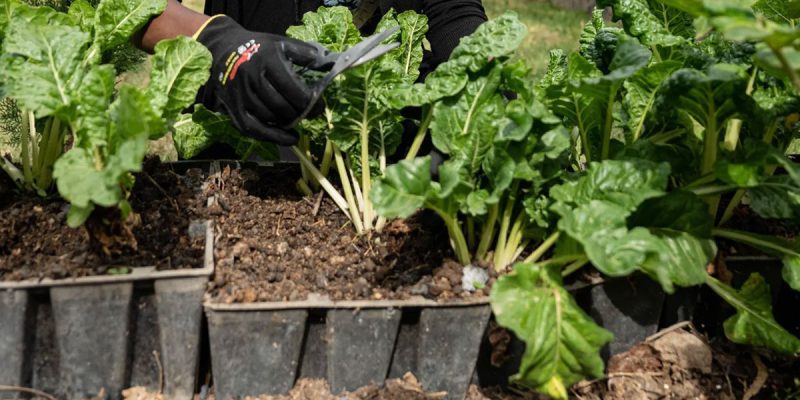
Salad greens in a raised bed or container produce continuous harvests through cut-and-come-again growing. A 4×4 foot bed produces enough salad greens to replace most of a family’s store purchases for several months of the growing season, at an annual input cost of $5 to $15 in seeds.
Tomatoes in full sun produce prolifically through the summer season. Cherry tomato varieties especially are low-effort, high-yield, and produce quantities well in excess of what most families can consume fresh — excess that can be frozen or preserved.
Container Gardening: No Yard Required
Container gardening has enabled food production in apartments, condos, and homes with limited outdoor space. Most vegetables can be grown in containers if the container is adequately sized, the location receives sufficient sun, and watering is consistent.
For apartment balconies, the priority crops: herbs (any container, any size, any sun), cherry tomatoes (5-gallon minimum container, full sun required), lettuce and salad greens (12 inches deep container, partial sun acceptable), and hot peppers (5-gallon minimum, full sun).
Container gardening has higher per-plant water costs than in-ground gardening because containers dry out faster. Self-watering containers (with built-in reservoirs) reduce the labor and attention required for container watering significantly.
Calculating Your Actual Return
A realistic financial return calculation for a beginner urban garden:
Setup costs (year one only): raised bed or containers $50 to $200, soil $30 to $80, seeds or transplants $20 to $40, basic tools $20 to $50 if you don’t have them. Total first-year investment: $120 to $370.
Annual production value for a 4×8 foot raised bed growing herbs, lettuce, and tomatoes in a good season: fresh herb equivalent $150 to $300, salad greens $80 to $150, tomatoes $50 to $120. Total: $280 to $570 per year in grocery value.
First-year break-even is likely but not guaranteed. Second year and beyond, with setup costs eliminated, a well-managed small garden produces $280 to $570 in grocery value from $30 to $60 in annual input costs — a return ratio that makes gardening one of the highest-value activities available to food-budget-conscious households.
Preservation: Extending the Value of the Growing Season
The growing season for most climates is limited to five to eight months. Extending the value of summer production through preservation creates food value across the year rather than just during the summer glut.
Freezing is the simplest preservation method. Most produce freezes reasonably well — blanched and frozen green beans, corn, and summer squash maintain good quality for six to twelve months. Cherry tomatoes freeze whole and work perfectly in cooked applications.
Pesto and herb oils made at peak summer herb production and frozen in ice cube trays extend the herb savings across winter months. A summer basil plant produces enough for dozens of pesto portions, which can be portioned and frozen for winter pasta and pizza use.
Canning and fermenting require more skill and equipment investment but produce shelf-stable preserved foods with very low ongoing input costs. Fermented vegetables (sauerkraut, kimchi, pickles) are particularly accessible as preservation methods for beginners.