 By
By Why This Decision Actually Matters
The choice between a Roth IRA and a Traditional IRA is a tax optimization question that plays out over decades. Get it right and you potentially save thousands in taxes over a career and retirement. Get it wrong and you’ve made an inefficient choice that’s hard to reverse after the fact.
Both are excellent retirement savings vehicles — the choice between them is one of the better financial optimization problems to have. The mechanism is the same: contributions up to the annual limit, invested in whatever securities the account holds, growing for decades. The difference is when the tax benefit is realized.
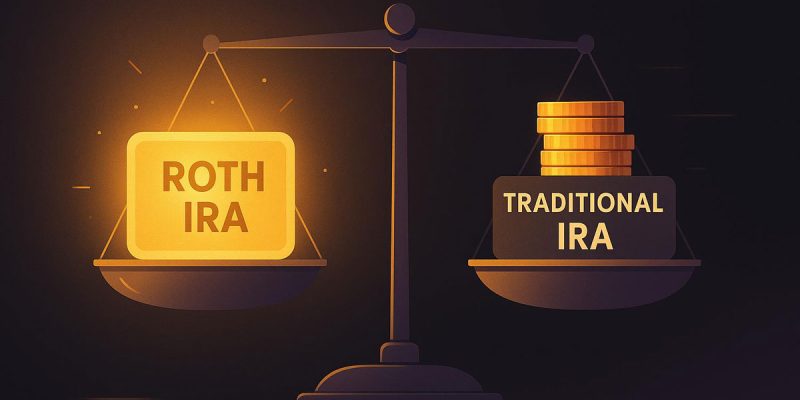
Traditional IRA: you contribute pre-tax money (or tax-deductible money), reducing your taxable income today. The money grows tax-deferred. You pay ordinary income taxes on withdrawals in retirement.
Roth IRA: you contribute after-tax money (no current deduction). The money grows tax-free. Qualified withdrawals in retirement are completely tax-free.
The Core Question: When Will You Be in a Higher Tax Bracket?
The fundamental Roth vs Traditional question is: will you be in a higher tax bracket now or in retirement?
If you’re in a lower tax bracket now than you expect to be in retirement: the Roth wins. Paying taxes now at a lower rate and withdrawing tax-free later at a potentially higher rate saves money.
If you’re in a higher tax bracket now than you expect to be in retirement: the Traditional IRA wins. Deducting contributions at your current higher rate and paying taxes in retirement at a lower rate saves money.
If you’re unsure (which is honest for most people, since predicting future tax rates and retirement income is genuinely uncertain): using both types (split contributions) provides diversification across the tax treatment, which is a reasonable hedge.
Who Should Generally Choose the Roth
Young people early in their careers are the clearest Roth IRA candidates. If you’re in the 22 percent or lower federal bracket and expect income growth throughout your career, you’re likely in a lower tax bracket now than you will be later. Paying taxes now at 22 percent and withdrawing tax-free in retirement when you might otherwise be in a 24 or 32 percent bracket produces real savings.
People who expect significant non-retirement income in retirement also favor the Roth. If you’ll have pension income, rental income, or other taxable income that pushes you into a significant bracket in retirement, the tax-free Roth withdrawal avoids stacking additional taxable income on top of that.
People who want maximum flexibility favor the Roth. Roth contributions (not earnings) can be withdrawn at any time without penalty or tax — a feature the Traditional IRA doesn’t offer. This makes the Roth slightly more liquid in a pinch, which some people value.
Who Should Generally Choose the Traditional IRA
High-income earners in peak earning years are the strongest Traditional IRA candidates. If you’re in the 32 percent or higher bracket now and expect to be in a lower bracket in retirement (because your income will drop when you stop working), the deduction today is more valuable than the tax-free growth.
People who need the tax deduction now to make the contribution work also favor Traditional. If the reduction in taxable income from a Traditional deduction meaningfully affects your effective tax rate for the year, the immediate benefit is real and valuable.
Note: Traditional IRA deductibility is subject to income limits if you or your spouse is covered by a workplace retirement plan. Above these limits, the contribution is non-deductible, which changes the calculus significantly — a non-deductible Traditional IRA is generally a worse option than a Roth when available.
The Backdoor Roth for High Earners
Roth IRA direct contributions are phased out at higher income levels — in 2026, roughly $150,000 for single filers and $236,000 for married filing jointly. Above these limits, you can’t contribute directly to a Roth.
The backdoor Roth is a legal strategy for high earners to access Roth treatment anyway: contribute to a non-deductible Traditional IRA (no income limit), then convert that Traditional IRA to a Roth (paying tax on any growth since the contribution). When done with fresh contributions with no growth, the tax is minimal.
This strategy has some complexity (particularly the pro-rata rule for people with other Traditional IRA funds) and is best executed with an understanding of the mechanics or with tax advisor guidance. But for high earners who want Roth benefits, it’s a legitimate and widely used option.